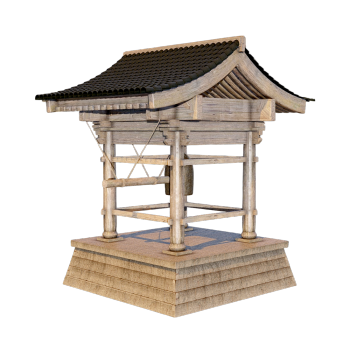
The bell tower of a Japanese temple
This building is the bell tower of a Japanese temple. This kind of building is mainly used to house large temple bronze bells and is used to call the time, gather monks for religious ceremonies and ring on special occasions such as the New Year. This modern common bell tower is usually open on four sides, without walls, so that the bell can travel far away. It is in a traditional East Asian architectural style, with a sloping tile roof and a wooden frame structure. In ancient times, bells were sometimes used as fire alarms or military communication signals in addition to religious uses.
Japanese traditional architecture
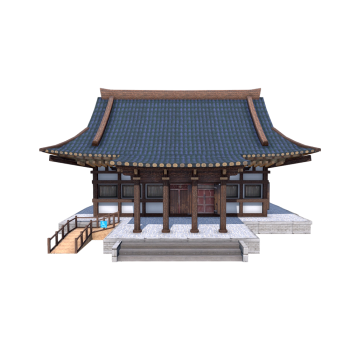
A traditional Japanese style building with typical deep eaves, dark tile roof and simple white wall wood structure. The roof is typically built into the mother house (corresponding to the top of the mountain in China), but its slope is relatively gentle and the eaves are far-reaching, which is a common practice of traditional Japanese wooden buildings to prevent rain and shade. The roof is covered with dark (perhaps dark blue or navy blue) tiles, and the overall tone is darker than the gray of the previous picture. The building sits on a high stone bench with a wide stone step in front. There appears to be a wooden corridor or slope on the left, possibly to connect to other buildings or as a barrier-free access.
Japanese Shrine
Shinto shrines are social houses that worship and honor various deities in Shintoism, and are the oldest type of religious architecture in Japan. Due to the close connection between Shintoism and the daily life of the Japanese people, shrines are very common. Since the 7th century, shrines have implemented a "replacement" system, which means they are rebuilt every few decades. Shinto shrines generally do not have incense offerings, whether it is a traditional tradition or a modern evolution. When people go to a shrine, they usually first clean their hands with a long handled wooden spoon by the pool in front of the shrine, then go to the shrine worship halls on both sides of the ridge, throw some change into the donation box with wooden bars, pat their hands a few times, and pray together.
Triple Pagoda of Faji Temple in Japan
The signboard of Faji Temple is the Triple Pagoda, which is the oldest triple pagoda in Japan, built during the Asuka period in 706 AD. At that time, China was in the Tang Dynasty, and Wu Zetian had just passed away the previous year. Emperor Zhongzong of Tang, Li Xian, succeeded to the throne. The Asuka Era in Japan began in 592 AD, when the first female emperor in Japanese history, Emperor Tsuchigu, ascended to the throne. In this year, the Chinese Mainland was in the 593 year of Emperor Wen of the Sui Dynasty's "Kaihuang Zhizhi", when the ancient emperor appointed the prince of the stables, the son of tomorrow's emperor, as the crown prince and regent. This was the famous "Prince Noble" in Japanese history and Japanese Buddhist history.
Residential ruins from the Yayoi period in Japan
Pit Dwelling is an ancient form of residence where people dig a one meter deep hole underground and cover it with a roof, forming a dwelling called Pit Dwelling. This type of residence was used throughout Japan before the Yayoi period during the Wa period. Due to their semi underground structure, they are less affected by external temperatures, making them a very comfortable place to live: cool in summer and warm in winter.
Residential ruins from the Yayoi period in Japan
Pit Dwelling is an ancient form of residence where people dig a one meter deep hole underground and cover it with a roof, forming a dwelling called Pit Dwelling. This type of residence was used throughout Japan before the Yayoi period during the Wa period. Due to their semi underground structure, they are less affected by external temperatures, making them a very comfortable place to live: cool in summer and warm in winter.
Japanese torii
It is an iconic annex building of Japanese shrines, mainly used to distinguish the divine realm from the secular realm where humans reside, symbolizing the entrance to the divine realm. It usually consists of two pillars and two crossbeams, and sometimes hangs a plaque with inscriptions on it. It is usually made of wood and painted with raw paint. The color is usually vermilion, which is believed to have the power to dispel demons, like a monk's barrier. In Japan, people believe that torii can fulfill their wishes, so the custom of worshipping torii has been popular since the Edo period. Torii is not only a part of the shrine, but also an important symbol of Japanese culture.
Guishan City Tian Shou Xiao Wa
The Kameyama Castle Tensho Showa is a tiger tile placed on the roof of the Kameyama Castle Tensho in Tanba from the late Edo period to the early Meiji period in 1852. The author and era can be seen from the belly of the beast head tile. It is said that the dragon gave birth to nine sons, and one of them was called Chi Kiss, also called the tail of the owl and the mouth of the owl, which moistened his throat and was thick and easy to swallow, so he became a swallow roof figures at both ends of the temple ridge and took it to fight the fire. After being introduced to Japan, it was called "chuo", which is roughly a whale like sea beast that seems fierce and capable of eating people.
Popular Models
Shrine
115 View
King Kong Hercules Wood Carving
166 View
The bell tower of a Japanese temple
189 View
Japanese Samurai Helmet
117 View
Random Model
AHTS VOS Hunter (1979)
147 View
Inonotus obliquus
172 View
influenza virus
312 View
Renault 6
170 View
IZH-49 Soviet Motorcycle
337 View
Japanese battleship IJN Fuso
170 View
Royal Swordfish Specimen
190 View
Retro Military Technology Radio
190 View
Double Dancing Arcade
256 View
Japanese fox wooden mask
164 View